A Practical, Science-Backed Transition Strategy**
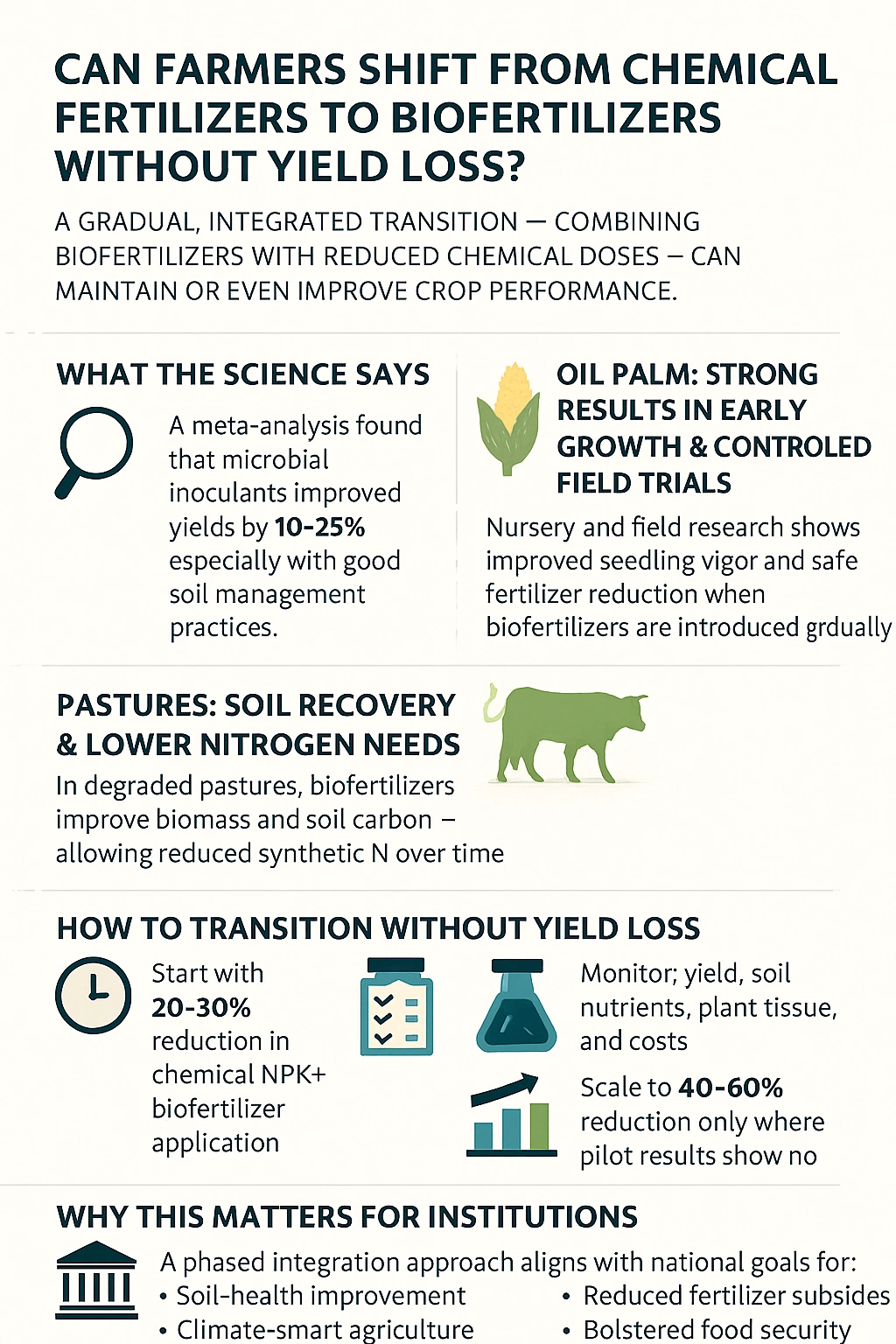
Many farmers worry that moving away from chemical fertilizers may reduce yields. But research shows that a gradual, integrated transition — combining biofertilizers with reduced chemical doses — can maintain or even improve crop performance.
🔬 What the Science Says
A major meta-analysis found that microbial inoculants improve yields across many crops, with average gains of 10–25%, especially when used with good soil management practices.
Source: https://pmc.ncbi.nlm.nih.gov/articles/PMC5770357/
FAO’s Integrated Plant Nutrient Management (IPNM) framework recommends combining mineral fertilizers with biological inputs for reliable, low-risk transitions.
FAO guidance: https://www.fao.org/.../integrated-plant-nutrient-management/en/
🌽 Corn (Maize): Proven Synergy
Studies show that biofertilizers + reduced chemical N (20–40%) often match or outperform full chemical fertilizer programs while improving nutrient-use efficiency.
Example study: https://pmc.ncbi.nlm.nih.gov/articles/PMC11202668/
🌴 Oil Palm: Strong Results in Early Growth & Controlled Field Trials
Nursery and field research shows improved seedling vigor and safe fertilizer reduction when biofertilizers are introduced gradually.
Example: https://pmc.ncbi.nlm.nih.gov/articles/PMC10222945/
🐄 Pastures: Soil Recovery & Lower Nitrogen Needs
In degraded pastures, biofertilizers improve biomass, root activity, and soil carbon—allowing reduced synthetic N over time.
Study: https://pmc.ncbi.nlm.nih.gov/articles/PMC7969760/
📈 How to Transition Without Yield Loss
1️. Start with 20–30% reduction in chemical NPK + biofertilizer application
2️. Run pilot plots before scaling
3️. Monitor: yield, soil nutrients, plant tissue, and costs
4️. Scale to 40–60% reduction only where pilot results show no downside
5️. Ensure quality biofertilizers (viable counts, safe storage)
🏛️ Why This Matters for Institutions & Governments
A phased integration approach aligns with national goals for:
-
Soil health improvement
-
Lower fertilizer subsidies
-
Climate-smart agriculture
-
Reduced dependency on imported chemicals
Additional Global References for Policymakers
CGIAR Research on Soil Health & Biological Inputs
https://www.cgiar.org/initiative/soil-health/
FAO: Soil Microbiome & Plant Productivity Reports
https://www.fao.org/3/cb8348en/cb8348en.pdf
UNEP: Reducing Nitrogen Pollution Through Bio-Based Approaches
https://www.unep.org/resources/report/global-assessment-nitrogen-cycle
European Commission – Biofertilizer Regulatory Framework
https://food.ec.europa.eu/plants/fertilising-products/eu-fertilising-products-regulation_en
ICAR (India) – Research on Biofertilizers & Encapsulation Technologies
https://www.worldbank.org/en/topic/agriculture
https://icar.org.in/content/biofertilizers-research
🌱 Final Takeaway
Yes — farmers can shift from chemical fertilizers to biofertilizers without yield loss, but only if done gradually and scientifically.
Global research consistently shows that integrated nutrient management delivers:
✔ Stable or increased yields
✔ Lower fertilizer costs
✔ Improved soil health
✔ Reduced environmental impact
✔ Greater long-term resilience
This is the scientifically supported path for countries aiming to build climate-smart, fertilizer-efficient, and sustainable agricultural systems.
Integrated nutrient strategies deliver stability for farmers and sustainability for governments.
Tags: -